Aug 7, 2014 | Blog
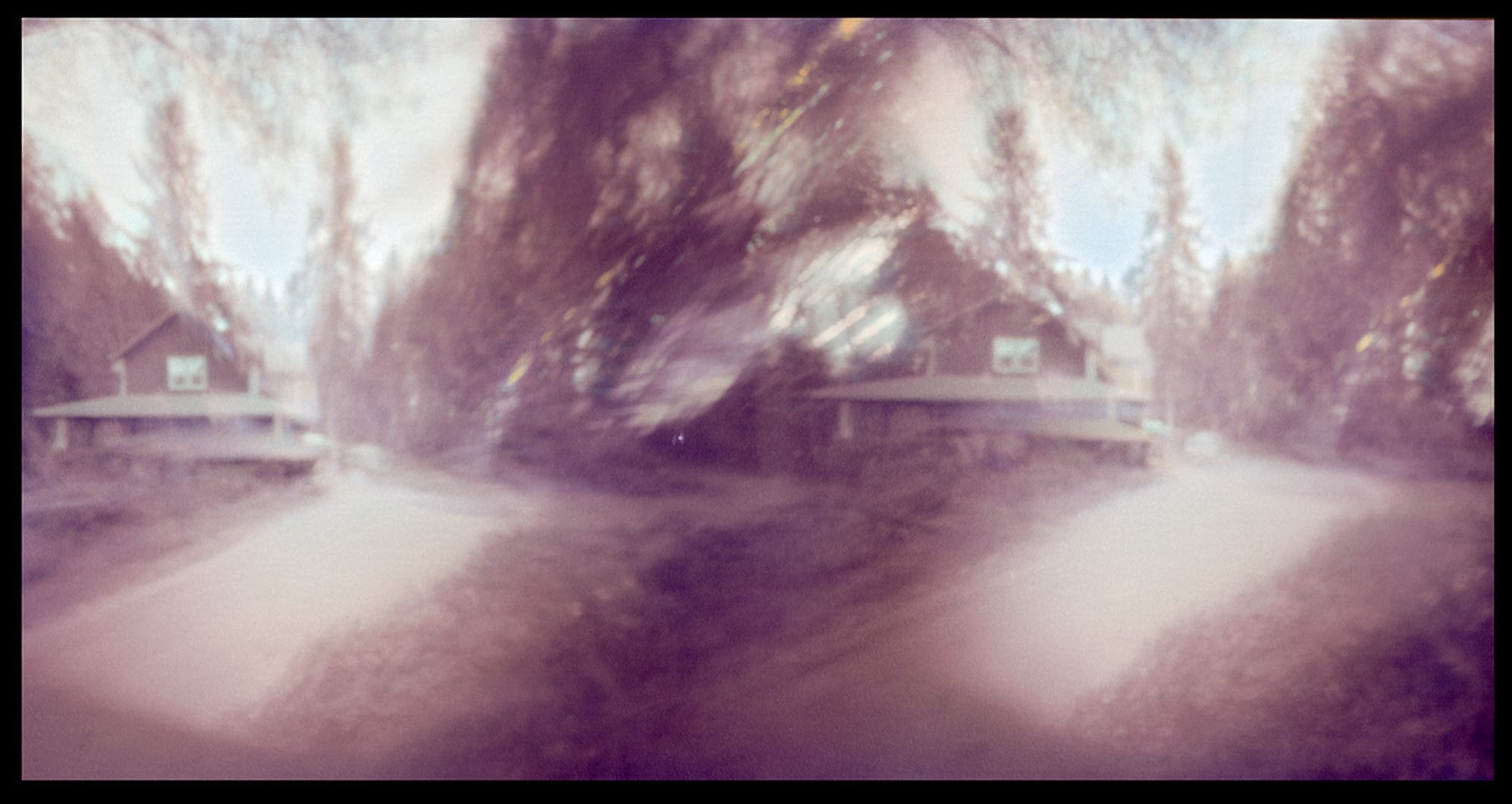
Sometime ago I found a box of negatives from an old Mamiya twin lens that slipped when the film advanced. I loved that camera; it made great double exposures, sometimes intentional, sometimes not. In the box was this image of Jess, taken around 2002, a double exposure and for some reason, I must have turned the camera on its side for one of the exposures. Can you see the close up of Jess’ face in the first image? Her head is turned and she looks straight at the camera, the small profile (in the image on the right) forms her left eye. The two images together create an optical illusion, like the vase/face test.
The image was made right after Jess discovered music shows on First Avenue in Seattle. She was constantly listening to music and would pose only if she could wear headphones. I am so glad she did. At the time we were watching a lot of old Star Trek shows hooked on them really and her kind of Borgian look must have been influenced by them. I made this diptych in Photoshop after scanning the negative. The diptych enables the viewer to see both pictures on the negative which pop and compete and then blend together. You could get the same effect with a single print, you would just have to rotate it. The intent is to make a really big darkroom diptych, maybe make it into a mandala. See it all four ways. Thanks Jess for posing! Wonder if you still listen to Sugarcult.


Aug 7, 2014 | Blog
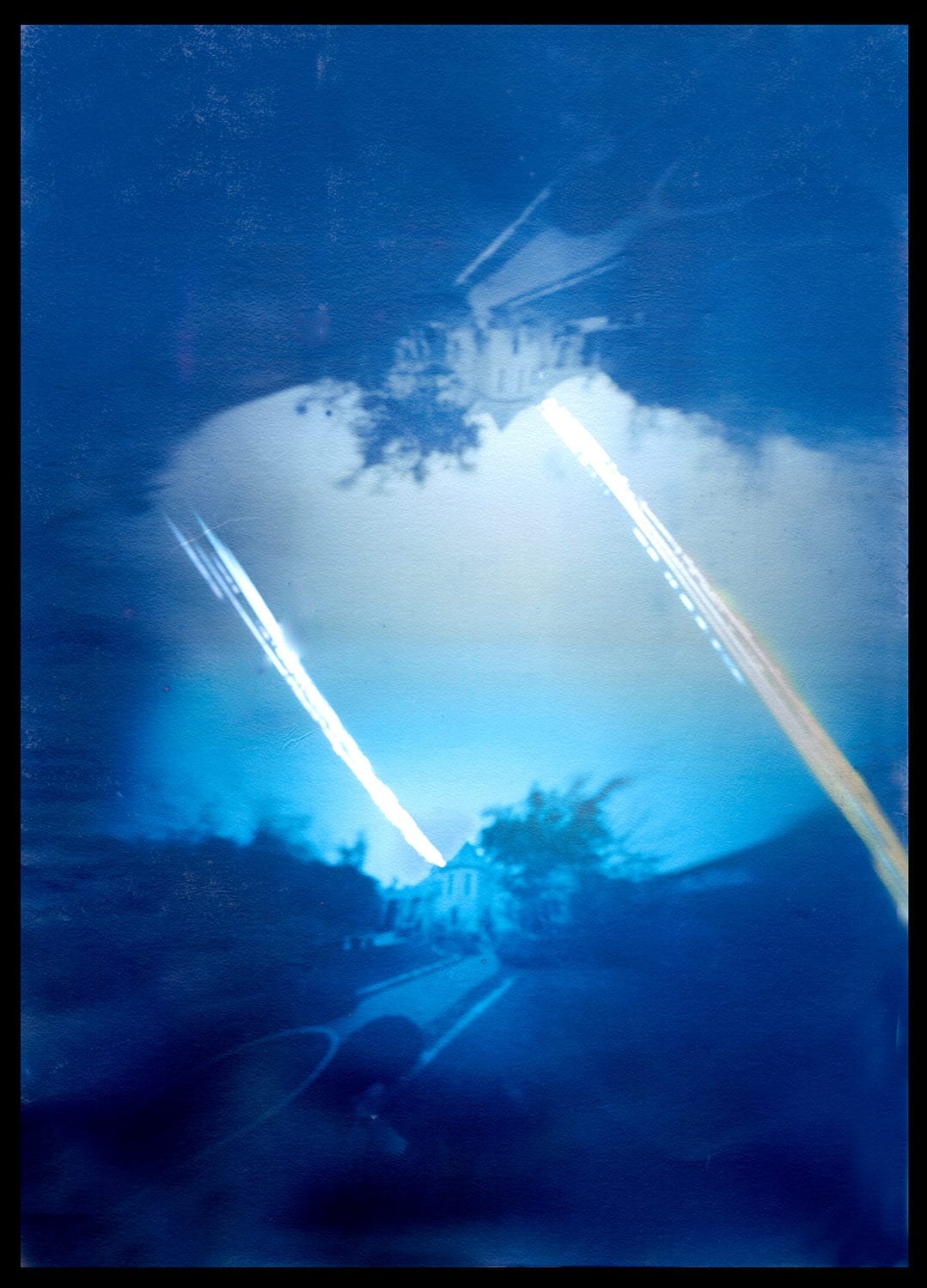
First let me say that there are no bad pinhole images. Of all the pinholes in the archive, there is not one single bad one. People fret about where to place the camera but ultimately it does not matter. Each image is a wild ride with light and shape and time. These exposures record long periods of time, the path of the sun, subtle comings and goings of the populace in the landscape and of course the light. The long simple slowness of the whole process records memory more than moment. Each are photographs filled with so many moment they become the antithesis the single decisive moment. And yet they remain simple little landscapes, lightly or brightly colored, aglow on a screen where they have landed after simple beginnings in an a simple metal tin. The miracle of pinhole photography!
As I look at the archive, I am struck by the the light again and again. In the past year, pinhole project photographers have experimented and become adept at using all types of cameras. They have built two hole and four hole cameras, round cameras, round panoramic cameras. Several people have done 10 plus images. I thank all you pinholists who come back again and again. I promise you we will have a way to search for your image in the archive soon. Given that, I ask you dear reader to go to the archive and let me know which ones are your favorites. I will do another blog later in the fall with viewers favorites if we get enough response. Enjoy these standouts below. Some are mistakes, all experiments, most at least three week exposures a few much longer.

Eric Riedel

Carina Laukatis. 4 hole camera

Ryan Cox 2 hole camera

Aerin Amore Looking Up

Amanda Siefert

Chase Lehotsky

Chiara Carcano. 2 hole camera.

Gregory Staley

Apr 19, 2014 | Blog
My first encounter with pinhole photography was in 1986 when late one night, my husband and I punched a hole in the brick wall of the landing outside my studio door to see if we could put a window there overlooking the vacant lot. The next morning when I went upstairs to go into the studio, the vacant lot outside flooded onto the wall opposite the hole. It was a camera obscura! The image was projected by that crude hole and it was elegant and dreamlike. Still, I did not think to use the pinhole camera in my own work or make an actual camera until about 5 years later when I got a 4 x 5 pinhole camera design from my friend, Craig Barber, (www.craigbarber.com) a pioneer in pinhole photography. I was teaching photography in a community college, looking for ways to engage students and pinhole photography seemed a perfect fit: it was inexpensive, students could build their own cameras from scrap board and it taught them an enormous amount about exposure. I tried out Craig’s design and shot some dixie cups sitting on a potter’s wheel. I fell in love. The students loved it too and about a year later, I was trying to figure out a way to capture what I saw under the 8x loupe that I wore around my neck in the darkroom. I was entranced by the way everything, not just negatives and contact sheets, looked under the loupe. How to get up close and capture that beautiful glowing light that made any old detritus look good? I actually had a dream one night that I could do this with a pinhole camera. I got up in the morning, duct-taped a loupe to a pinhole camera and took a photograph of a butter knife on a napkin leftover from dinner the night before. You can see the loupe itself in the image, the camera was too wide-angle, but I knew I was onto something I wanted pursue.
For the next several years, I photographed many things under the loupe that I attached to a Leonardo 4 x 5 pinhole camera. I shot these images on ISO 400 film, mostly guessing the exposures, developing the negatives in my dusty basement darkroom. I enlarged them to 16 x 20 prints, as large as I could go before the soft focus fell apart. The series which I titled LoupeHoles, (you can view some of these images under the portfolio section) consisted of all kinds of subjects that could fit under the loupe but gradually I started to concentrate on dead things, old dusty cast-offs, things that nobody else paid attention to. Thinking back, these images were a part of my pyschology of the time: dark, somewhat morose, isolated images that were really reflections of my own personal nightmares and fears. But the prints were beautiful, big and gutsy, toned in blue and gold and selenium. For many years, I sent them out to various calls for work, showed them to dealers and curators and was always rejected. The work remained unseen until Eric Renner and Nancy Spencer from the Pinhole Resource (www.pinholeresource.com) offered to publish some of the images in the Pinhole Journal (Volume 20, #2) and include The Point of A Pencil in their book, Pinhole Photography: Rediscovering a Historic Technique, (third edition). Then Eric and Nancy accepted six prints into their collection of pinhole images at the Pinhole Resource. Recently, The Point of A Pencil became a part of the New Mexico State History Museum pinhole collection. The rest of the images remain unshown.
After years of working on the LoupeHoles, I acquired in 2000, a roll film pinhole camera, a Zero 2000. For about five years, I shot hundreds of rolls of film with this camera, self- portraits, portraits, landscapes and still life. These images are not so dark, more about movement, soft focus, the dream-like state that Pinhole Photography can reference. I photographed landscapes in and around the area where I grew up on the Kitsap Peninsula, west of Seattle. Using this camera made me rethink the landscape, understand it not as a representation of reality but as a representation of memory. In 2006, I started to teach digital photography only and pinhole photography was laid aside. I had no time for darkroom. I needed to make a living and to do this I had to learn digital photography.
But pinhole photography did not languish. I started the Pinhole Project, so anyone without a darkroom could make a camera on old school paper. Lately, I have been wondering if I should not just ditch my digital cameras and go back to film and pinhole based image making. I have realized that I am a very intuitive, low tech photographer in this high tech age. Go to the archive on this website and take a look at the amazing array of images from over 600 photographers. (www.janetneuhauser.com/thepinholeproject) While I love digital photography (really just another form of image making), I miss the film based pinhole image, its mystery, its slowness, its magic. I have been making the long exposure color negative images. The next step is to clean the cobwebs out of darkroom and start again with black and white negatives. So much to do.
 Dixie cups on a potter’s wheel: my first pinhole photograph, circa 1994
 Butter knife on a napkin: paper negative with positive. First pinhole photograph with an 8x loupe attached to a camera, circa 1996
 The Point of A Pencil, from the series, LoupeHoles
Featured image: Self-Portrait: Day Off, made with a Zero 2000 pinhole camera

Apr 13, 2014 | Blog
The first time I photographed my daughter Jess was about twelve hours after she was born. The nurse brought her to me in my hospital room, she was wailing with what I later figured out was hunger. I laid her on the slice of light falling on the bed and took a few pictures. She had beautiful eyebrows, wide open eyes and she quit crying right away, looking at me steadily while I made a few exposures. The image from that morning became the start of the Kid Pictures: photographs of Jess as she grew up. I thought all these years that the Kid Pictures were about Jess but lately I have realized that they also are about me as I remembered/relived my childhood. Looking at the Kid Pictures, the viewer might infer that Jess was an unhappy and depressed child. In fact, that child was me not Jess. The images I made of her were dark and painful: how I felt about my past at that time. I don’t think Jess ever thought the photographs were real documents of her life, even when she posed with chicken pox all over her body: we made the images consciously thinking bad; willing to extend ourselves into what we believed was the fictional world of the photograph.
Since a photographic record of my childhood (except for the awkward, posed family shots) does not exist, I have often thought about how it would look in pictures. If I could go back and recapture my past what images would I take? Probably not the bad and sad moments; maybe the sun when it sank behind the mountains, huge and snowcapped, or the wind as it tore through the neighbor’s orchard, or the old apple tree where I perched high up in the branches to read. That is how I see it now. Did I have to raise a child to come to terms with my own childhood? Maybe. Did I have to take dark, solemn photographs of her to meet the past head on? Probably. Thank goodness for photography which gave me an entry into my subconscious memory. And thank goodness for Jess and the other kids who were willing to pose for me. Maybe it was a relief to them not to have to be cute kids for a picture. Maybe it actually was how they felt at the moment. But really, what kind of accurate record is photography anyway?
Still, it is Jess who is the subject of the Kid Pictures. I can only hope that she remains as enthusiastic now about the images as she was when she was a kid. I used to say that the Kid Pictures were about a lot of different kids. In fact, I did photograph six or seven other kids over the years as well. The images of them are of the same ilk. Perhaps we can look at the images of all the kids as simply a wide assortment of stories told by a photographer and her models, intrepreted by the viewer, supported by the arrangement of light and subject in the frame just like every other image. As the photographer, my intent is/was not important . But at the time, I was trying to make a “serious” portrait of the kids, especially my daughter, not the Hallmarky phony photographs of an imagined childhood. The irony is that the Kid Pictures have turned out to be a different type of reality, fictional perhaps but still based in the idea of light hitting a subject and reflecting back onto film. Still based on the fact that my daughter was posing for the camera, honing her acting skills, but mustering up real emotions.


To see more of the Kid Picture Portfolio, go to: http://www.janetneuhauser.com/kid-pictures/

Apr 5, 2014 | Blog
Why is the word selfie so distasteful to me? I am not a stranger to the self portrait; I have made them regularly since 1978. But what is the difference between a selfie and a self-portrait? The selfie is a quickie, in this quick world of ours. It is a snapshot in best superficial sense of the word, the selfie is an ad; a Facebook post, a few quick likes, it does not linger. The self-portrait is slow food. It simmers then surfaces in the strangest of ways. It reveals itself slowly and asks more questions than it answers. Bragging rights do not exist in self-portrait. More often, the self-portrait is embarrassing and can come with apologies and disclaimers. Self-portraits exist usually in editions of 1. Self-portraits are not big sellers, at least not while the photographer/artist is alive. (I can attest to this. I had a show of 40 self-portraits and sold one).
I have read that the world would be a better place, if everyone, from the worst possible lowest form of human kind to the best most incredible person, all got four hugs a day. Perhaps the selfie is an electronic hug. I admit that I do make selfies. I point and shoot the iphone and get a tiny little fix, a second of instant gratification. I like that electronic hug. I make a little connection; I get a little shock of recognition. It feels good. But then I get off the internet and it feels even better to work on an idea, make a self-portrait, print an image, a beautiful, rich print to put on the wall and contemplate. To ask some unanswered questions about myself. I hope that I am not too old school about the selfie vs. self-portrait controversy. I ask only that when people point and shoot and make a selfie, they try a little harder to make an image that is not superficial. We all have the need to create reproductions of ourselves and the iphone selfie makes it too easy. I think photography should not be taken so lightly; it should be difficult; the self-portraits we make especially should be difficult.
That said, here are two images made of me by me. Does one seem more “selfie” than the other?